The books
The Body That Ran
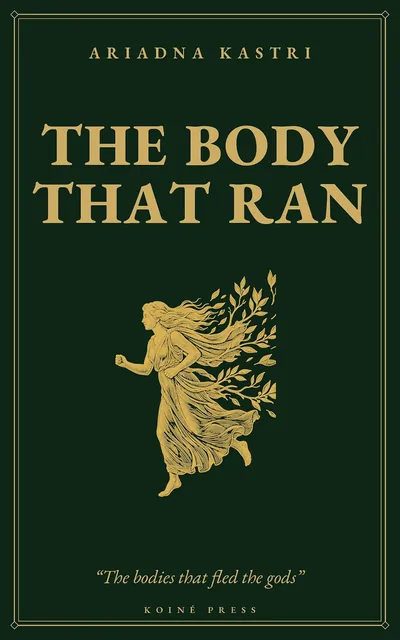
Somewhere in your memory there is a girl turning into a tree. You half-know the story — girl runs, god chases, tree happens — and that half-knowledge is the problem this book exists to fix.
- eBook (Kindle)$12.99
- Paperback$21.99144 pages
Prices as seen on Amazon on 22 September 2026. The price on Amazon is the one that applies.
Every claim carries its book and line.
How this book works
Somewhere in your memory there is a girl turning into a tree. Maybe she arrived through a marble statue you saw on a school trip or a screen, fingers bursting into leaves at the exact moment a god’s hand closes on her waist. Maybe she came through a footnote, a perfume ad, a crossword clue. Her name is Daphne, you half-know the story — girl runs, god chases, tree happens — and that half-knowledge is precisely the problem this book exists to fix.
The passage continues in the book
And this is how every claim is checked:
She stands by her venture; greedy, Ovid says, for the prize of glory, she rushes into her fate — in sua fata ruit (6.50-51).
The scene Ovid actually wrote runs a hundred and sixteen lines. The part everyone remembers ends at line 556. What happens in the eleven lines after that is the part nobody puts on a postcard, and it changes what the story means.
This book is neither a novel nor an adaptation. It reads seven transformations slowly, with the book and line number printed beside every claim, so you can audit each one against any translation on your shelf.
• Daphne becomes a laurel with a god’s breath on her neck.
• Io, turned into a cow so a rape can be hidden from a wife, writes her own name in river sand with a hoof.
• Philomela, her tongue cut out precisely so she cannot name her rapist, weaves the accusation into a tapestry — and it is read.
Around fifty of the poem’s tales involve rape or attempted rape. No scene is given more detail than the argument needs; the violence is contained the way a museum contains a blade — visible, labelled, behind glass.
Between the chapters, six short interludes ask what a body actually is: you, or something you are locked inside of, or something others get to reclassify.
Every citation is real and printed where you can see it. Don’t take my word for it. The verdict is yours.
Book four of The Classics They Never Told You. Reads on its own.
This book, in other languages